
The Circular Revolution: How Plastic Recycling is
Powering “Indian Vision 2030”
The upcoming 6th Plastic Recycling Conference
Asia (PRCA2026) in Delhi marks a pivotal moment for India’s industrial landscape.
At Wealth+ Advisers, we truly understand transition of
plastic industry in depth, and we must look beyond simple recycling.
Plastic industries are in a full-scale re-wiring and it
shows that now India can handle materials.
As we approach 2030, the plastic sector is shifting from
being a environmental “Villain” to becoming a high-tech feedstock provider for
India’s $7 trillion economy.
The Macro-Economic Re-Wiring
In 2026, plastic industry currently valued at $50 billion
and projected to reach $68-$70 billion by 2030. This growth in industry is not
just about more plastic but it is a better plastic.
From Waste to Feedstock
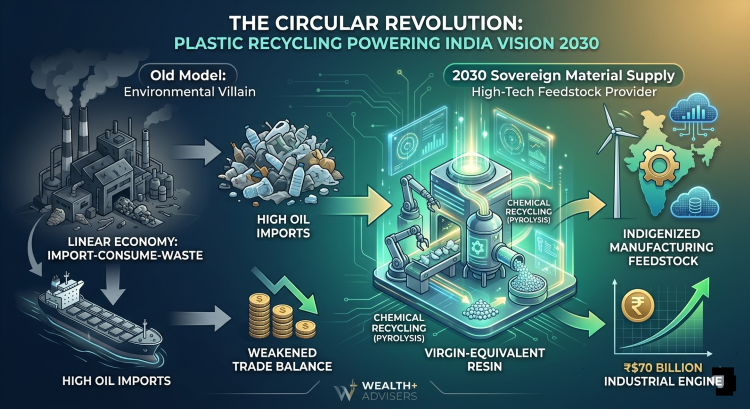
India is now focusing and moving toward a sovereign material
supply. By 2030, expected recycle would over 8.5 million tonnes of plastic
annually. This reduces our reliance on crude oil imports for virgin resin, and
that will improve India’s trade balance.
Plastics are essentially solidified oil, traditionally plastics
are manufacturing from petrochemical feedstocks (naphtha and ethane), refined from
crude oil.
India imports roughly 85% of crude oil, which impact our
manufacturing sector highly vulnerable due to sudden price rise of crude oil
like current situation 2026 energy crisis has triggered.
By recycling 8.5 million tonnes of plastic, reduces the need
of equivalent amount of virgin resin produced from imported oil. In this way,
we are mining our own waste for raw materials.
Reduced oil imports direct narrow current account deficit
(CAD).
Mechanical recycling typically results in lower quality of
plastics, but new technology (advanced chemical recycling) is making possible
for plastic recycling to achieve virgin-equivalent quality. Mechanical methods melt
plastic while chemical recycling breaks the material down at a molecular level.
The Shift to “Sovereign Material Supply”
Sovereign Material Supply means control entire life-cycle of
the material- from collection to re-manufacturing, without dependency on
international supply chains.
In the world of geo-political uncertainty relying on own
waste materials as “feedstock” (raw materials), which ensures that sectors like
automobiles, electronics, and packaging can continue to function even price
rise continue.
Strategic Indigenization should be focused on
strategic portfolio allocation means focusing those companies which use their
own recycled feedstock and those are less affected by the volatility of the
dollar or international freight rates.
The Economic Multiplier Extended Producer
Responsibility Rules 2022 (EPR) has set the goal of 8.5 million tonnes, scaling
up toward 2030.
Many categories of packaging in India will be legally
required to contain 30% to 60% of recycled plastic by 2028-2030.
Strategic Portfolio Allocation
This macro-shift is why we track specific stocks in our Wealth+
Strategy
Supreme Industries: Their scale of business allows
Supreme Industries to set up massive collection networks, securing their own sovereignty
supply for their piping and infrastructure products.
Moat
A dominant player in “Physical Internet”, providing
essential piping and ducting for India’s 5G Fiber rollouts.
Debt-free balance sheet and massive distribution network.
Their high margin value added products provides superior earnings and
stability.
Company expects Q4 20-26% volume growth and full year
FY26-27 expected volume growth guidance around 15-17% in plastic piping segment.
In long-term for 2030 12-13% volume growth is expected.
Know How Healthy Your Portfolio Really Is
Upload your mutual fund or stock portfolio and receive a free portfolio dashboard. Unlock a comprehensive audit with portfolio diagnostics, risk analysis, overlap detection, and detailed educational insights.
In Jan 2026, management revised its EBITDA margin guidance
downgrades to 13.4-14% from 14.5-15% due to falling global PVC prices.
Re-rating potential, expected margin expansion of 90bps in
next two years. Polymer (PVC) prices have likely bottomed out. VAP grows by 18%
YOY.
Mold -Tek Packaging Ltd
Representing the shift toward digital manufacturing through
fully automated, robotic In-Mold Labelling (IML) processes.
The Moat: Their "stickiness" with giant
food and FMCG clients, combined with their entry into digitized, traceable
packaging, aligns perfectly with the transparency requirements of a circular
economy.
Techno Electric Massive demand for industrial power
for advanced chemical recycling and the decarbonization of the grid, where
Techno Electric provides high-voltage power infrastructure required to run the
massive, energy-intensive chemical recycling plants in the future.
Moat
A record orderbook of over 10,951 crore and zero-debt
balanced sheet make them a structured differentiated in the power EPC space.
Summary: The 2030 Vision
By 2030, the plastic industry will not be seen as a
"waste generator" but as a resource provider.
The Bottom Line for 2030
This transition will change mindset from a National Liability
(waste) to Strategic Asset (feedstock) and this this transition also moves
India one step closer to Aatmanirbhar and also ensures that our Industries
growth is no longer dependents on fuel from abroad, but to a circular loop at
home
- Old
Model: Oil Γ₧ö Virgin Plastic Γ₧ö
Waste (Import Dependent).
- 2030
Model: Waste Γ₧ö Feedstock Γ₧ö
Circular Plastic (Sovereign & Self-Reliant).
#WorldHealthDay #SIP #Compounding #IndiaVision2030
#WealthPlus #StrategicAsset Selection #FinancialWellness #BSEIndia
#InvestmentMindset
Surendra Jauhari | Wealth+ Advisers SEBI
Registered Investment Advisor (Individual) Registration No:
INA0000021474
Disclaimer:
Investment in securities market are subject to market risks. Read all the related documents carefully before investing.
Registration granted by SEBI and certification from NISM in no way guarantee performance of the intermediary or provide any assurance of returns to investors. The Wealth+ Strategy and stock analysis provided are for educational purposes based on current 2026 market data. Intrinsic value and margin estimates are subject to growth assumptions and commodity price fluctuations.
The content shared here is for information and educational purposes only and should not be treated as a direct recommendation. Clients are advised to consult their signed advisory agreement for personalized risk profiling and suitability before executing any "Strategic Portfolio Allocation" on the Wealth+ platform.